
Southland, home to approximately 104,800 New Zealanders, has quietly surfaced as a regional digital stronghold distinct from larger urban centers.
Abundant renewable electricity, a pragmatic community outlook, and grassroots focus have combined to sustain pockets of under-the-radar 8-wire innovation.
The region's industry growth persists amongst near zero government backing.

Southland, emcompassing Stewart Island and Fiordland
Southland's Bid for Sustainable Mining
Sam Kivi is chief technology officer and director at Grid Share Limited, a New Zealand company focused on renewable energy grid balancing, with an involvement in sustainable Bitcoin mining.
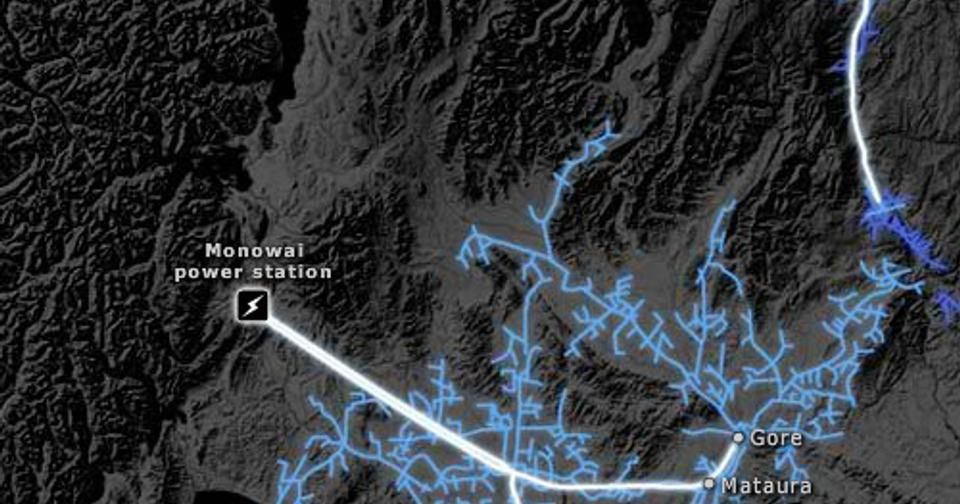
Grid Share operates at the Monowai Power Station, using surplus hydropower for mining and curtailing during peak demand to support grid stability.
Kivi outlined the regional opportunity.
"For Grid Share the Southland region has a huge potential - the obvious one is the abundance of renewable electricity, and relatively low cost of electricity on average," Kivi said.
"The region's industrial sector is also of interest to Grid Share as we seek to enable decarbonisation of process heat using our waste heat as a supply source."

Monowai Power Station Centenary - celebrating 100 years since it officially opened in 1925.
"I must also mention the pragmatic and open minded approach of the people of Southland - we have found operating in Southland really encouraging on this front."
He described the operational model.
"Grid Share is an energy solutions company first - aiming to accelerate the growth of renewables and decarbonisation efforts - and Bitcoin mining has become a powerful tool on that front," Kivi said.
"By using surplus hydro power when grid demand is low, and curtailing our operations when demand is high in winter we're able to improve sustainability of the renewable electricity sector as well as Bitcoin mining - a yin and yang relationship."

Grid Share's facility at the Monowai Power Station
Kivi addressed government support.
"While Grid Share has had wonderful support from local Regional Business Partners Network, and engagement with the Electricity Authority, Ara Ake, and start up programmes with government-sourced funding, so far we have been unable to secure direct funding support for the many decarbonisation and renewable electricity growth initiatives that Grid Share has been working on," Kivi said.
"Unfortunately it seems a widespread misunderstanding of Bitcoin and Bitcoin mining remains a challenge in securing serious consideration for our initiatives."
"However these misconceptions are starting to change, as objective, peer reviewed studies debunk earlier false narratives in the media about Bitcoin mining's potential environmental benefits."

Monowai Lake - fueling one of NZ's over 100 hydroelectric power stations
Invercargil's Jamie Cross from Cross Group commented on regional momentum.
"The southern region as a whole is seen as a thriving region for technology not necessarily just in the crypto space," Cross said.
"Crypto is part of that broader 'digitisation' story."
"People are more comfortable with online finance, digital identity, and global platforms, so the mental barrier to crypto is lower than it was a few years ago."
He projected participation trends.
"Southland has a strong base of business owners and skilled people, and once a few early adopters prove a tool saves time or improves outcomes, it spreads quickly."
"On crypto specifically, I expect steady growth in participation, but mostly through small allocations and practical use-cases rather than speculation."
"Over time I'm hoping that the technology will feel less like a punt and more like just another piece of technology that people will use on a day to day basis, and one that will be important that their accountant understands."

The region is often cited as New Zealand's most beautiful
Activity in Southland is Broad
Jamie Cross founded Cross Group in 2011 in Invercargill, and specializes in crypto accounting, tax, and financial reporting.
Cross described client involvement.
"We have 100+ clients holding Crypto or are involved in Crypto as part of their business," Cross said.
"We have a mix of clients who are either holding small allocations through to some where crypto investments are their dominant investment."
"It is not one stereotype," Cross said.
"We see interest across small business owners, younger business owners who have grown up with the technology and have been exposed it especially when returning from overseas."

Farmers make up a portion of the countries approx 400-500k crypto users
"There's also a section of tradies and farmers who are also interested in but more from a personal investment basis rather than practical application of the block chain itself."
"But in summary a real cross section."
Kivi shared observations from community engagement.
"Through our engagement with the community around our Monowai operation, we've come to know a number of locals - often farmers and small business owners - and this has been a real privilege for me personally," Kivi said.
"Incredible conversations over a cup of tea have been had."
"Often there is not a lot of pre-existing knowledge around Bitcoin, but an openness to listen and enquire."
"There are exceptions though!"
"I've met farmers who have taken the time to inform themselves about Bitcoin, but largely in isolation."
"It seems there might be principles learned in successfully managing land and livestock sustainably for future generations that can also apply to Bitcoin and Grid Share's mission to accelerate our renewable energy growth and utilisation."

Wellington remains cautious on NZ Bitcoin innovation
Why isn't the NZ government Supporting this growth?
No political party in New Zealand adopted a formal public position on Bitcoin or crypto policy as of 2025.
Direct support from regional or central governments for Bitcoin-related businesses remains near zero.
Crypto continues to be treated as personal property under existing tax rules, with no dedicated framework or targeted funding streams for the sector.
Callaghan Innovation, the government agency charged with promoting business innovation, coordinated the Web3NZ initiative to deliver networking opportunities, hackathons and resources across the broader web3 ecosystem.
The programme, however, did not provide targeted assistance to regions such as Southland or to specific initiatives in NZ's sustainable Bitcoin mining sector.
Callaghan Innovation was disestablished as part of wider reforms to the science, innovation, and technology system announced in early 2025.
Government communications from the National Party, ACT, and New Zealand First continue to stress economic growth and innovation opportunities in public statements and strategies.
Yet these messages overlook emerging regional prospects, such as Southland's sustainable Bitcoin mining efforts powered by surplus renewable energy.
Engagement from MPs around Blockchain NZ and Bitcoin Policy Institute NZ's 2025 parliamentary events revealed wariness among some attendees.
When approached for a list of participating MPs - including those from National, ACT and NZ First - there was reluctance to share names, citing concerns over positive association with Bitcoin or cryptocurrency.
This reflects an exploratory rather than committed interest among policymakers.
Southland National MP Joseph Mooney, who facilitated the Bitcoin-related discussions in Parliament during 2025 - including sessions with Bitcoin Basin representatives and policy-focused events - has not responded to previous requests from Cryptocurrency NZ on these matters.
These gaps persist despite isolated parliamentary briefings, highlighting a focus on growth rhetoric from parliament that lacks concrete backing for the local ecosystem and regional economies.