
WELLINGTON - Building on a timeline of progressive engagements since 2019, New Zealand's Parliament welcomed pioneering Bitcoin and blockchain advocates in two 2025 sessions, marking historic milestones in political engagement with digital assets, signaling potential for the nation's tech sector.

ACT Party MP: Nicole McKee (Minister for Courts and Associate Minister of Justice) using Bitcoin
June 2025 - Bitcoin Breaches the Beehive
The Bitcoin Policy Institute NZ, alongside Kiwi Bitcoin experts and Lightning Pay NZ - the country's final standing locally owned Bitcoin exchange - made history on June 4 by presenting to over 20 MPs from National, Act, and NZ First parties.
Invited by National's Southland MP Joseph Mooney, the session featured Bitcoin Basin Ambassador Nell Hunter on Queenstown's circular economy, Lightning Pay NZ's co-founder Rob Clarkson on business and energy opportunities, and Bitkiwi's Paul McArthur on monetary tech.

NZ Bitcoin Experts and MPs learning about Bitcoin mining
A live Canaan Avalon Mini Bitcoin miner was plugged in at parliament, and MPs - including Associate Justice Minister Nicole McKee - tried wallets, with Maungakiekie MP Greg Fleming receiving Bitcoin in a hands-on demo.
"Our goal was to share that the Bitcoin movement is accelerating... It’s time for New Zealand to take note," said Hunter. Clarkson added mining could "balance the grid... reduce energy prices for consumers."
MP Joseph Mooney was contacted for comment but did not respond.

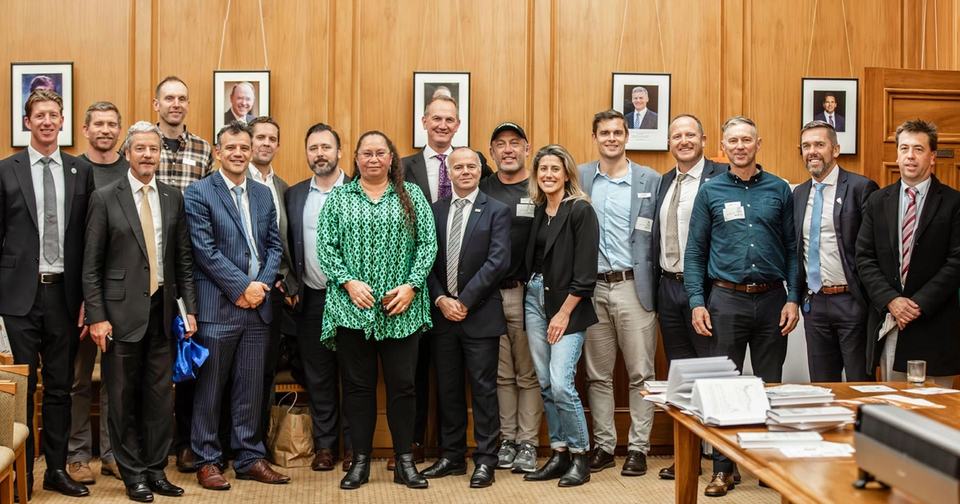
Core members of the Parliamentary Digital Assets Working Group (DAWG)
October 2025: Blockchain NZ’s Parliamentary Working Group
Building on this momentum, Blockchain NZ launched the Parliamentary Digital Assets Working Group (DAWG) on October 15, a cross-party, cross-sector initiative uniting 15 MPs (15% of Parliament, including two ministers and reps from five select committees), regulators like the FMA, and industry leaders.
The group convened October 14-15 to foster understanding and tackle policy gaps, drawing on UK/Australian models.
"There's definitely an appetite inside Parliament for Digital Assets... clear bipartisan support," said Executive Director Trevor Topfer.
"I certainly wasn't expecting that from the first DAWG Meeting." Experts warned of billions in lost GDP without action, highlighting blockchain tech solutions for sectors like agriculture and logistics.
When asked for a total list of attendees, Ministers were reluctant fearing it would be seen as an endorsement rather than driven by curiosity.

Jayden Hunt; member of DAWG, programmer and Cryptocurency NZ developer
Having industry help MPs understand where they can actually make a difference - that two-way dialogue is long overdue. Right now we're hemorrhaging talent overseas because builders don't see a future here, so creating an environment where people want to stay and build isn't just nice to have, it's urgent to ensure NZ keeps up with global pace. What this means for future adoption is simple: if we get the regulatory framework right now, we create the foundation for real innovation - businesses will incorporate here, developers will build here, we'll attract capital instead of watching it flow to more forward-thinking jurisdictions, and we'll see young leaders emerging who choose to build New Zealand's digital future rather than someone else's.
Policy, Jobs and the Horizon
Politically, these events showcase coalition leadership with National and Act at the forefront, though inclusivity hints at budding bipartisan support from Greens and others, with the NZ ‘crypto vote’ yet to develop an identity.
This unfolds amid NZ's minimal and largely reactive crypto framework: VASPs adhere to AML rules under DIA, while IRD taxes crypto as property up to 39%.
The FMA regulates when assets qualify financial products and provides guidance on tokens, but beyond these, no comprehensive rules exist.
A lack of direct regulation fuels NZ’s current crypto banking crisis, where many local entrepreneurs and international services face stone walls trying to create businesses, jobs and services which involve the use of digital assets.
This hands-off framework contrasts sharply with the USA’s proactive policies to become the ‘crypto world leader’, such as establishing a Strategic Bitcoin Reserve and FIT21 for market incentives - leaving New Zealand lagging without similar drivers for innovation and growth.
Bitcoin Policy Institute NZ's upcoming Nov 12 private event is likely to announce further policies.
Timeline of Parliamentary Engagement
Key interactions show building momentum in NZ parliament:
- May 2019: Blockchain NZ advocates for national strategy, presents to select committee.
- July 2021: Finance Committee launches crypto inquiry, opens submission - 266 submissions.
- Sept 2021: Blockchain NZ submits on innovation/risks.
- Feb 2022: BitPrime, Easy Crypto give oral evidence to MPs on market dynamics.
- Aug 2023: Inquiry report published, recommends cautious development.
- Feb/Mar 2024: Government responds, addresses inputs.
- Sept 2024: Blockchain NZ submits on banking competition, highlights debanking.
- June 4, 2025: Bitcoin Policy Institute NZ’s presentation to 20+ MPs.
- Oct, Nov, Dec 2025: banking competition hearings ongoing, crypto links discussed.
- October 2025: Blockchain NZ hosts Blockchain 101 session (Oct 14) and launches DAWG (Oct 15) at Parliament to educate MPs/ministers and address policy gaps/economic potential.