
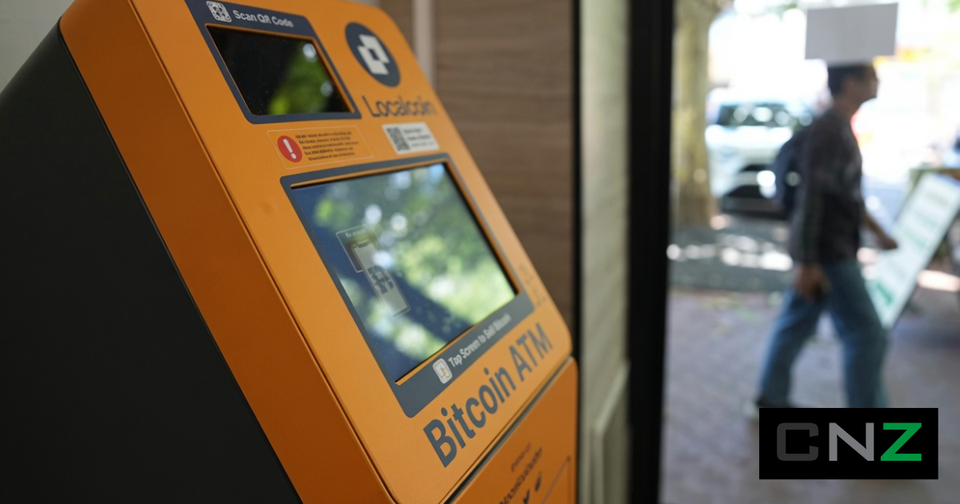
WELLINGTON - Cabinet is not proceeding with a blanket ban on cryptocurrency ATMs, Associate Justice Minister Nicole McKee confirmed today.
Cabinet had agreed in principle in June 2025 to ban the machines as part of its overhaul of the Anti-Money Laundering and Countering Financing of Terrorism (AML/CFT) regime, but that decision was subject to further analysis.
McKee said the analysis is now complete and did not support a full ban.
"Banning something is a serious decision that should not be taken lightly," McKee said. "Cabinet has now considered the evidence and agreed that a blanket ban is not the right response at this time."
McKee said crypto ATMs present real risks, particularly for converting cash into virtual assets quickly, but the analysis also found legitimate uses, including for cash-reliant New Zealanders wanting to access or invest in virtual assets.
"New Zealand should be a country that welcomes innovation while taking criminal misuse seriously," she said.
Instead of a ban, Cabinet has agreed to create regulation-making powers to let the Government set maximum transaction thresholds on crypto ATMs, or ban cash payments for high-risk virtual assets if clear evidence of harm shows up locally.
Officials have been directed to consult with crypto providers and users before any threshold is set.
"This gives the Government practical tools to respond to risk while preserving space for legitimate business, investment, and personal choice," McKee said.
The AML/CFT Omnibus Amendment Bill, which carries the power, is to be introduced to Parliament later this month.
CNZ reported in July that no ban had been confirmed, despite widespread reporting to the contrary after McKee's original 2025 announcement.
McKee told CNZ at the time that any ban hinged on a final Cabinet decision.
That decision has now been made.
Part of a wider AML overhaul
On 1 July, the Department of Internal Affairs became New Zealand’s single AML/CFT regulator, taking over supervision of registered banks, virtual asset service providers, non-bank deposit takers and securities firms, bringing all reporting entities under one regulator.
The Government has estimated the value of money laundered in New Zealand each year at $1.6 billion, the figure underpinning the AML/CFT National Strategy 2026-2030.
An industry levy to help fund enforcement, including the Financial Intelligence Unit and DIA’s supervision role, was designed in consultation with industry and becomes payable from July 2027.
A weapon of choice for scammers
The Banking Ombudsman reported two cases involving crypto ATMs in March.
A woman withdrew $31,500 after responding to a fake job advertisement and deposited it into a crypto ATM on the scammer’s instruction, telling her bank teller the money was for a car.
A man lost nearly $65,000 over six months funnelling withdrawals through crypto ATMs, believing he was investing.
Banking Ombudsman Nicola Sladden said the speed and irreversibility of the transactions made the machines especially risky when used under pressure or at someone else’s direction.
In both cases, the banks did not reimburse the customers, and the scheme found nothing in what the customers told their banks should have raised a red flag at the time.
Machines and the market
More than 220 crypto ATMs operate across New Zealand.
They are run predominantly by North American operators CoinFlip and Localcoin, after local NZ-owned providers faced banking access issues, a dynamic CNZ has previously reported on.
Fees on the machines often exceed 10 to 20 per cent per transaction, significantly higher than online alternatives.