Jailed Hamilton drug boss hands the Crown 7.46 Bitcoin under Police settlement
The Crown is getting 7.46 Bitcoin from jailed drug boss Caleb Malcom Gilchrist. How it will be stored and sold is secret: the Official Assignee withheld both from CNZ, saying only that no crypto in its care has ever been lost.

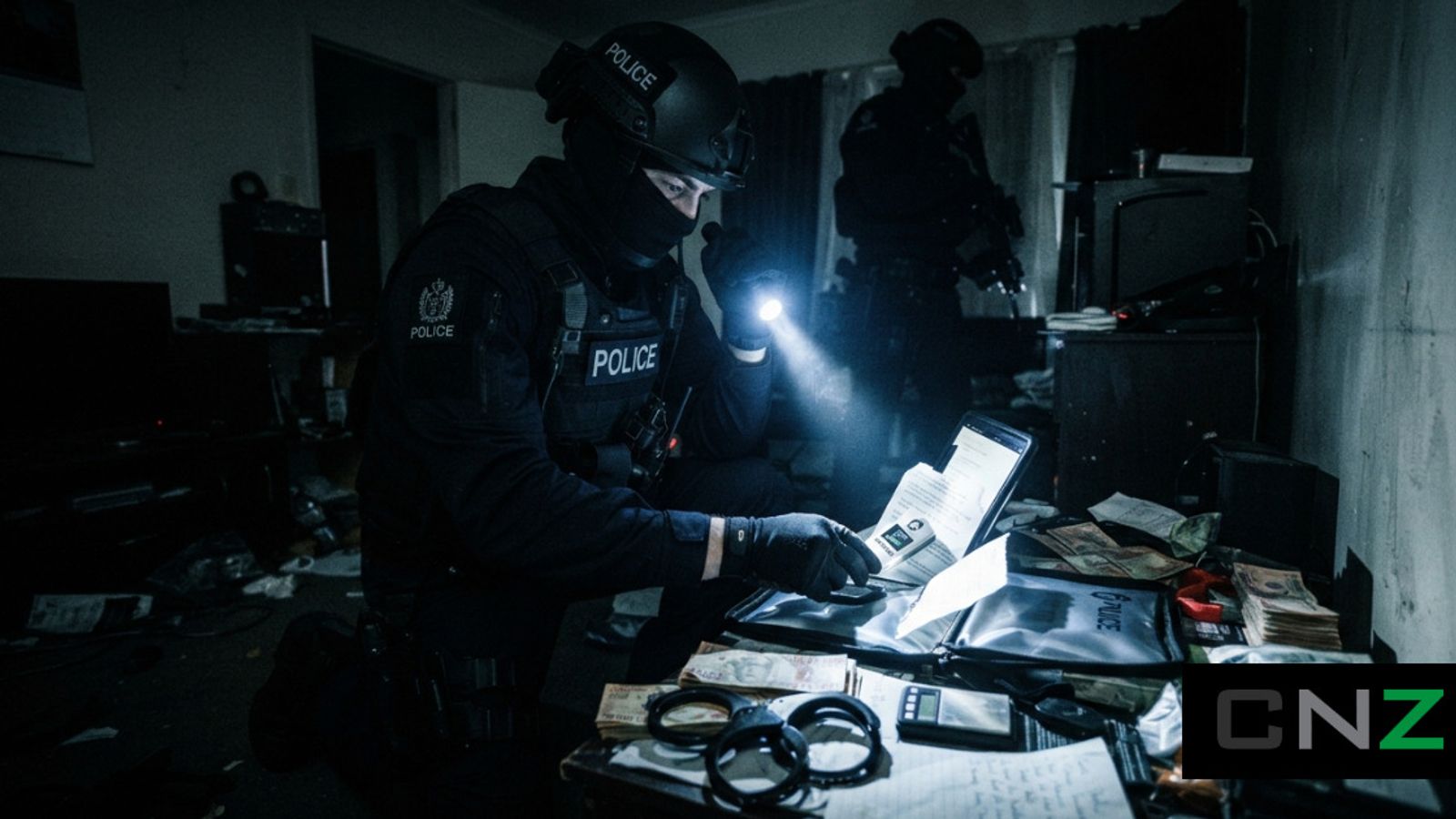
The High Court at Hamilton approved a settlement with Police on 27 October under which jailed Hamilton drug boss Caleb Malcom Gilchrist forfeited 7.45893652 Bitcoin, three vehicles and cash to the Crown, worth about $1.04 million, the judgment shows. The Waikato Times reported it on 10 November.
In June 2025 he pleaded guilty to 13 charges relating to methamphetamine, MDMA, mephedrone and ketamine in Operation Poapoa, in which he was found to have a leading role. He is serving 14 years in total, including a further sentence over a second drug syndicate, Operation Equinox.
Gilchrist accepted engaging in significant criminal activity but disputed Police's claim he had benefited by at least $3,464,400. He said the Bitcoin "was obtained through legitimate financial investing", the judgment records.
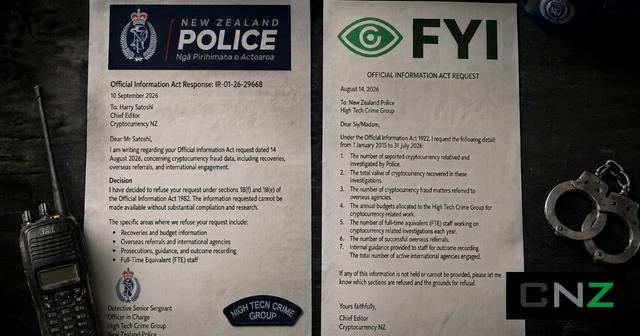
Police told Cryptocurrency NZ in an Official Information Act (OIA) response in August that 13 crypto assets had been forfeited since 2015, and none in 2026 up to 3 July.
Forfeited cryptocurrency goes to the Crown. The Official Assignee turns it into fiat money on the Crown's behalf, the Ministry of Business, Innovation and Employment said in an OIA response to CNZ on 18 November.
The court ordered the Bitcoin to vest "in the Crown absolutely" and be in the Official Assignee's custody and control. It had been restrained since October 2023. The three vehicles had already been sold; the Bitcoin had not.
The Official Assignee withheld how it holds and sells crypto. It said releasing operational details of this nature could compromise the security and integrity of those processes.
"There have been no instances where cryptocurrency held in the Official Assignee's custody has been lost, stolen or become inaccessible," it said.
Police could not say the same. In a separate OIA response, Police told CNZ that 2.851 Bitcoin seized in a 2015 drug case should have gone to the Official Assignee after the trial, but did not because of "an administrative oversight".
In 2021, Police found the paper wallet holding it had been destroyed during a review of a police station's exhibit storage.
Police have kept their side quiet too. In the same response, they withheld the current value of the crypto they hold and the amounts of less common coins they had seized, on the same law-enforcement grounds.
The Official Assignee withheld the type, amount, sale date and NZ dollar return for each of those 13 assets. It said the figures could be matched with public blockchain data to identify its wallets and the people it dealt with.
It said it had considered releasing them in a generalised or aggregated form, but refused that too: "even where individual data points are rounded or otherwise generalised, their release may still enable information to be matched with publicly available blockchain data."
The courts have published such details before. A 2024 High Court judgment, Commissioner of Police v Tthaedon, gives the public address of a wallet Police seized 12.314 Bitcoin from in November 2022, and the $482,920.01 the coins later sold for.
A forfeiture order does not, by itself, mean the Official Assignee has ever held the property.
"The fact that property is included in a forfeiture order does not, by itself, mean that the Official Assignee has previously had custody or control of that property," Russell Fildes, the ministry's national manager for insolvency and trustee services, told CNZ.
Alex Sims, an associate professor of commercial law at the University of Auckland, told CNZ Police should disclose at a high level how they hold seized crypto, as other custodians do. "As the Crown is essentially a custodian, it should be subject to the same custody standards as other custodians," she said.
CNZ has asked the Ombudsman to review the Official Assignee's decision, arguing forfeited crypto is public property and New Zealanders should be able to see how it is kept safe and what the Crown gets when it is sold.