Police 'cannot confirm' any offshore crypto scammer targeting New Zealanders has ever been prosecuted
Labour police spokesperson Ginny Andersen said better tracking of outcomes was part of a cybercrime focus. National's Minister of Police Mark Mitchell did not respond to requests for comment.

"I cannot confirm whether an overseas agency has charged or prosecuted any person for cryptocurrency fraud in relation to a Police referral."
New Zealand Police's High Tech Crime Group knows of no overseas charge or prosecution from the cryptocurrency fraud cases it has referred offshore since 2023, after 11 years of specialist crypto capability.
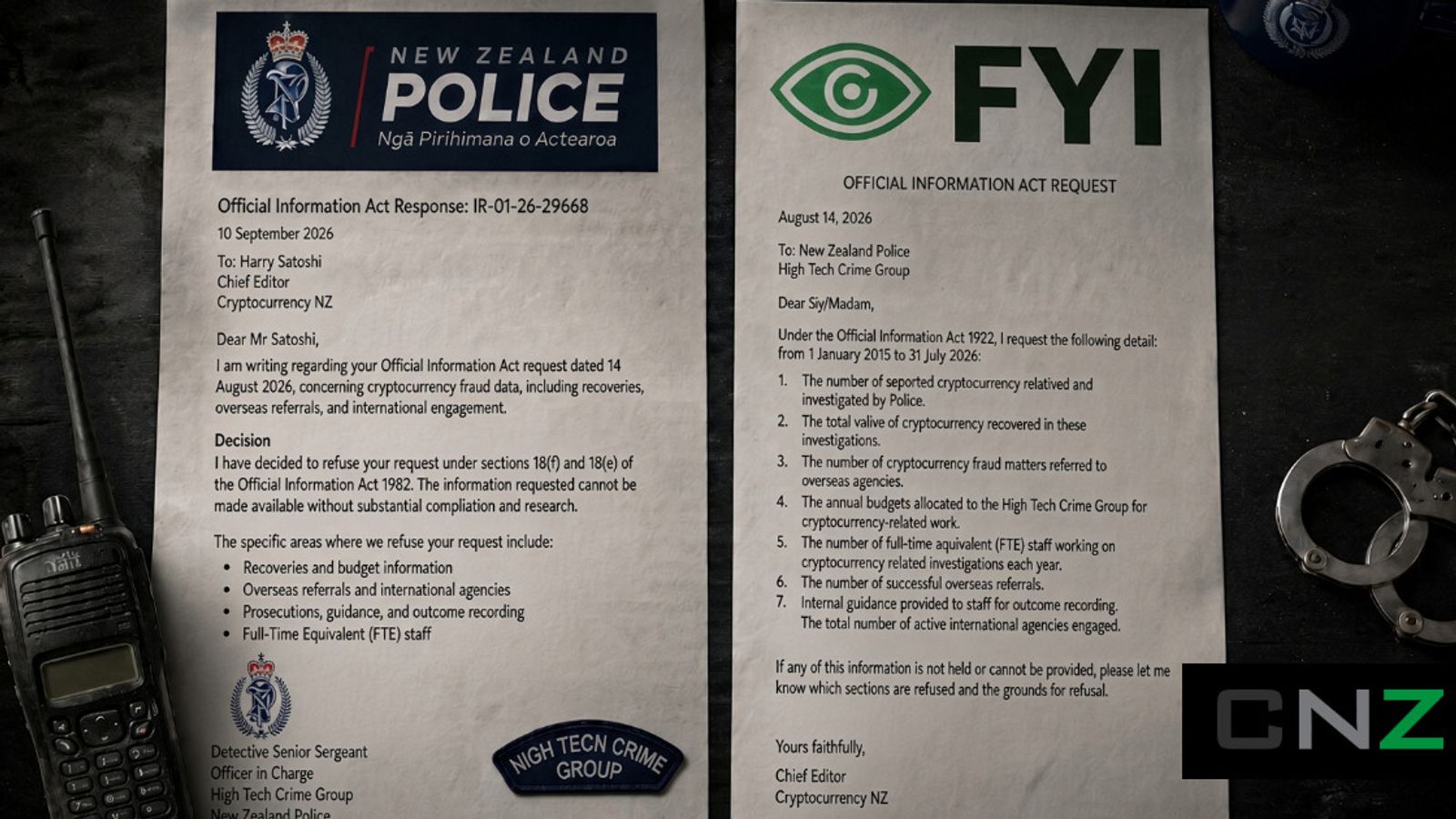
In a response to an Official Information Act request from Cryptocurrency NZ, the High Tech Crime Group said Police "works closely with foreign law enforcement partners to investigate and prevent cryptocurrency-related offending."
"I cannot confirm whether an overseas agency has charged or prosecuted any person for cryptocurrency fraud in relation to a Police referral," the response said.
CNZ narrowed the question in a further request. Asked whether the group had made at least one overseas referral since the start of 2023, Police said: "Yes."
Asked whether it knew of any that led to an overseas charge, Police said: "No."
Police records "do not routinely identify" any of those cases, and finding them would require the manual review of "a significant number of investigation files," it said.
Police have no specific policy on recording the outcomes of cryptocurrency fraud cases. The response pointed instead to their general National Recording Standard.
Yet Police's National Criminal Investigations Group has had cryptocurrency capability since 2015, Police told CNZ in August.
That month, CNZ reported Police have no system built for cryptocurrency fraud.
There is no offence category for it either - a crypto scam report is usually filed as blackmail, extortion or fraud, and nothing marks it as crypto.
A file sent on for investigation goes to one of Police's 12 districts, where it is prioritized on local demand. Police said that is not standardised nationally.
The specialists are not in the districts. Police's 8 to 12 specialist cryptocurrency staff sit in two units at headquarters in Wellington.
The same reporting found no recorded process for taking those cases across a border.
Few scam victims reach Police at all. Only 10 per cent of New Zealand scam victims reported it to Police, and 64 per cent of those who reported a scam to a platform or service provider saw no action or did not know the outcome, the Global Anti-Scam Alliance and Netsafe found.
Political response
"Financial fraud of any kind hurts New Zealanders, and victims deserve confidence their case is being followed through," Labour police spokesperson Ginny Andersen said in a statement.
"Labour supports a focus on cybercrime, and better tracking of outcomes is part of that."
Minister of Police Mark Mitchell did not respond to requests for comment.
He also did not respond to questions from CNZ in August.
New Zealand’s next Minister of Police will be named after official election results are declared and a new government is formed.
Police won't explain
CNZ asked Police why outcomes after an overseas referral are not tracked, whether that might change, and how Police judges its work with foreign partners without those records. Police did not answer them.
"We understand you have an OIA being progressed that addresses your questions," Police director of media Juli Clausen said.
"I consider that is the appropriate channel for your questions."
That request did not ask those questions. It asked whether referrals and overseas prosecutions had happened. CNZ told Police this on 2 November and asked again for an answer. Police's media team then said the questions were being treated under the Official Information Act.
On 5 November, Police refused them in full. Questions that require Police to "form an opinion or provide an explanation" are not official information, the response said.
CNZ put the questions to the media team again.
"We don't have anything further to add," the media team replied.
A handful of recoveries
In September, Police said they had helped recover stolen cryptocurrency for victims "on several occasions since 2015."
Asked how many, the High Tech Crime Group's Detective Senior Sergeant Shayne Precious said there have been four cases in which Police "successfully facilitated the recovery of stolen cryptocurrency for victims."
In an estimated 8 to 10 more, Police tried to get victims' crypto back and failed.
That is four cases since 2015 in which victims got stolen crypto back with Police help, by Police's own count. Police could not give exact numbers, because the information "is not stored in Police systems in a structured manner that can be readily queried."
In August, Police's media team told CNZ those recoveries were "very rare due to jurisdictional challenges and the unregulated nature of the cryptocurrency ecosystem."
No list, no guidance
Asked which overseas agencies they had engaged on cryptocurrency offending, Police said the force "does not maintain a master list."
Compiling one "would require substantial collation and research," the response said, and that part of the request was withheld.
Instead, it named some of the partners Police work with on fraud and transnational offending in general: the law enforcement agencies of Australia, Canada, the United Kingdom and the US, the ASEAN region, Interpol and Europol.
In June, Police said there were no typical processes, triggers or minimum threshold for taking a cryptocurrency case to an overseas agency.
Asked this time whether any broader guidance applied, Police said there was none, and investigators decide "on a case-by-case basis."
What comes next
Police said in June the Financial Crime Group held no data on referrals, joint operations or arrests in cryptocurrency cases, in response to an earlier request.
In August, Police's media team said the question of overseas prosecutions needed an Official Information Act request. CNZ filed it on 14 August.
CNZ filed a narrower request on 22 October, limited to the High Tech Crime Group since the start of 2023.
It asked whether any overseas referral had been made, whether any had led to a charge, and how many recoveries "several" meant.×
Police answered on 23 November, three days after the deadline, and apologised for the delay. The response did not address a fourth part, which asked for any briefings or reports to the Minister recording referrals, recoveries or overseas prosecutions.
CNZ is continuing its investigation into how crypto scams are handled in New Zealand.