
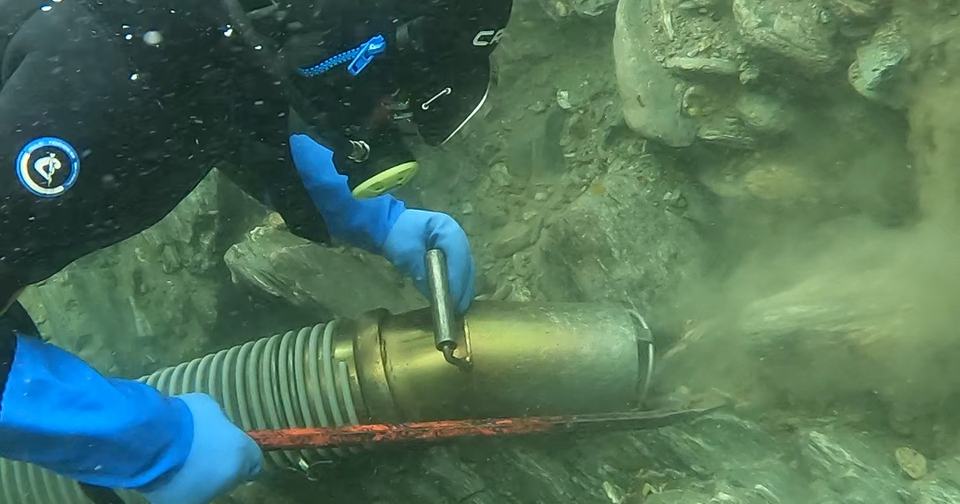
OTAGO — In the freezing creeks of Otago, Michael O’Keefe spends long days submerged in cold water, using a suction dredge to extract gold from riverbeds.
The work is physically punishing - heavy manual labour, volatile returns, inherent underwater risks - yet the sudden appearance of colour in the sluice box delivers an adrenaline hit that overrides the hardship.
When he surfaces, O’Keefe turns to Bitcoin. On TikTok (@michael0keefe, 128.3K followers, 8.2M likes) and Facebook, he documents his gold dredging trips alongside consistent Bitcoin accumulation, advocating modest daily buys and fundamentals to build exposure and self-custody knowledge.

The Realities of Dredging Otago Creeks
"Gold mining NZ rivers is hard work, freezing water, heavy manual labor, long days and volatile returns," Michael says.
"But when we are under the water it's like being in another world, peaceful and consuming.
“The outside world doesn't seem to exist."
"When the gold appears from beneath the overburden the cold disappears, your heart rate pumps and the real reward hits.”
“Still to this day, if a decent nugget appears we are out of the water hollering and hooting to each other."

Michael O’Keefe with his full kit, camped out along one of New Zealand’s rivers.
The setup is straightforward: metal detectors and a suction dredge that acts as an underwater vacuum, sucking water, gravel, and hopefully gold through a hose into a sluice box.
"The box separates the heavy materials and catches them in low pressure areas, the larger and lighter materials are sent back into the creek," he explains.
Safety is non-negotiable. "We always have 2 people working, anything underwater has risks and is not safe alone."
Despite the grind, "The worst day gold dredging is better than the best day working!"
Michael's interests provide a reminder that you can, in fact, just do stuff.
Under current Otago Regional Council rules, recreational suction dredging is permitted provided the nozzle internal diameter does not exceed 150 mm, it avoids Schedule 7 sensitive waterbodies during spawning periods, stays at least 20 metres from structures with riverbed foundations, causes no flooding or erosion, refuelling occurs outside the wet bed or with spill containment, activity is confined to the wet bed without bank disturbance, and no dredge operates within 500 meters of another.

A haul of Michael's gold nuggets
Gold Mining is in his Blood
Michael reflects on history.
"If the old boys 100 years ago had modern suction dredges there wouldn't be much gold left in these creeks!
"Maybe the odd bit of flood gold washed in over the years."
When asked about family connections, he responded:
"Mining and entrepreneurship is in the blood for sure."
"My mother was born in Reefton where her father ran a business to support the gold mining booms.
“He was the unofficial mayor of Waiuta for a time."
Waiuta's Blackwater mine (1906–1951) produced approximately 732,000–750,000 ounces of gold from the Birthday Reef from about 1.5–1.6 million tons of ore, making it the largest historical producer in the Reefton goldfield (total field output over 2 million ounces from 1870–1951).
These connections link to New Zealand's extractive legacy, from 19th-century rushes to industrial mining, and regulated small-scale dredging today.

A gold claim I spotted at a recent mission to Nivus Valley, Otago
Accumulating Digital Gold
To Michael’s 140K+ audience, he advocates a modest Bitcoin entry.
Bitcoin fundamentals are a common topic in his many hundreds of videos.
"My hope with the $10 a day into bitcoin is that I will inspire people to get some exposure to bitcoin and start learning," he says.

Michael's Tikotok where he advocates Bitcoin accumulation
"You don't need to be rich or 'risk' money you don't have.”
You can start stacking sats for the same amount as we spend on coffee a day.”
“I believe and hope that everyone should have some allocation to bitcoin, whether it be $10 a day, a week or a month. Even a one off buy just to learn about the technology and how to buy and store it."
When asked about the link of gold to Bitcoin, Michael spoke of similarities.
"Gold is the ultimate proof of work in the analog world - Bitcoin is the ultimate proof of work in the digital world.”

Bitmain Antminer s19j's submerged in water to assist with cooling
“Once you've got the fever for either you're hooked for life!
“I'm extra sick with the gold fever and the orange pills!"
When asked on Bitcoin mining links, Michael responded:
"Like gold mining there is no way to circumvent the work, no work, no reward. Even when you do the work there's no guarantee of reward everytime."
I asked Michael about what he see's as Bitcoin's true value proposition.
"Bitcoin is sovereignty and freedom for people who don't believe in the current world systems. A way to store our hard earned value that can’t be diluted."
"I would like to see the world running on a Satoshi standard 1 sat replaces $1.”
“Unlikely, but hope and conviction go a long way. In 20 years, I don't see Bitcoin still being called a crypto currency. It will just be currency."

A NASA rendering of Psyche 5, “the golden asteroid"; valued at approx $15.8 quadrillion USD.
Gold's Scarcity in a Changing World
When asked about the future scarcity of gold; speculating on asteroid mining, atomic manipulation and advanced methods of extracting gold from the ocean, Michel spoke on future supply:
"I would love to see the day that we extract gold from space.
"How cool would that be, like living in a sci-fi movie."
Ocean gold estimates sit around 20 million tons dissolved, but concentrations are extremely low - roughly one gram per 100 million tons of seawater in the Atlantic and north Pacific, making extraction uneconomic with current tech.
Near-Earth asteroids number in the thousands, with some potentially harboring many metric tons of gold, though amounts remain uncertain due to limited data.
NASA's Psyche mission, launched in 2023, is set to arrive in 2029 for detailed analysis via SpaceX.
There are no plans for direct gold extraction; while futurists, engineers and scientists alike envision drawing such asteroids into Earth’s orbit for processing; to be used here on Earth or in space manufacturing.
These activities are expected to have massive impacts on gold markets.
Skeptics counter that feasibility barriers preserve scarcity.
Distances are immense, costs are prohibitive, and returning materials would flood markets, crashing values.
However, like a colony of ants, wherever resources are, humans tend to follow.

The Large Hadron Collider (LHC) is the world’s largest and most powerful particle accelerator - consisting of a 27-kilometre ring of superconducting magnets with a number of accelerating structures to boost the energy of the particles along the way.
Atomic manipulation offers another theoretical path.
At the Large Hadron Collider near Geneva, scientists have detected the transmutation of gold from lead at 99.999993% the speed of light.
Initial runs detected gold generation equating to 29 picograms of yield.
Run 3 has nearly doubled output, but totals remain negligible - trillions of times less than needed for a single gram.
This scientific magic has realized medieval alchemy on a subatomic scale.
Yet arguments for scarcity dominate.
Gold transmutation is extremely energy-intensive, yielding atoms not viable quantities, with costs far exceeding gold's value.
The age of smashing atoms together to print others is still extremely experimental and early days.
Proponents, on the other hand, argue that future accelerators are bound to scale up, and that even miniscule production demonstrates proof of principle, and therefore production destiny.
Michael remains pragmatic.
"They can extract as much gold as they like out of the ocean or the ore of earth but when we find gold nuggets, that feeling can't be taken away.
“Maybe someday gold's scarcity is reduced, in my lifetime I'm not convinced."
Bitcoin’s scarcity is fixed at 21 million units.